From an uncertain career change to award-winning comedy, motherhood, faith and building platforms for women, Nomthandazo’s story is about much more than making people laugh.
There is a particular kind of courage required to make people laugh when life has given you enough reasons to cry. It is a courage that goes beyond stage presence, perfectly timed punchlines or the ability to command an audience. It requires an understanding of people, an appreciation of life’s contradictions and, sometimes, the willingness to turn your own experiences into stories that allow others to find humour in their own. For Nonto R, comedy has become more than a profession. It is a language through which she interprets life, confronts its complexities and connects with people who may have never experienced her particular journey but somehow recognise themselves in her stories.
Behind the laughter is Nomthandazo, a woman whose journey has travelled through journalism, insurance, unemployment, motherhood, grief, faith and the unpredictable business of entertainment.
She is an award-winning comedian, but also a wife, mother of five, creative producer and wellness advocate. Her story is not one of overnight success or a perfectly calculated career move. It is a story of discovering purpose in uncertainty, learning to trust a talent that had always existed and understanding that sometimes the most important performances happen away from the stage.

Her entry into comedy was hardly conventional. Having studied journalism, she eventually found herself working in insurance, following a professional path that provided stability but did not necessarily satisfy her deeper ambitions. Then came unemployment, a period that brought its own anxieties and forced her to reconsider what she wanted from life.Looking back, she describes that period as one of both fear and freedom.
There were financial responsibilities and the uncomfortable reality of not knowing what came next, but there was also an opportunity to ask herself a question she had perhaps not given enough attention to before.”When I found myself unemployed, it was scary because bills don’t stop just because you’re trying to find yourself. But at the same time, for the first time I had space to ask myself, ‘What do I actually want?'”Comedy entered that uncertainty. Not as a guaranteed escape from her circumstances, but as a possibility that demanded exploration.
Yet Nonto is not romantic about the decision to pursue one’s dreams. She understands that passion must coexist with responsibility, particularly in an industry where opportunities are rarely guaranteed.
“Would I tell somebody to quit their job without a plan B? Absolutely not!” she says
with the humour that seems to follow her even into serious conversations. “Sometimes faith is jumping, but sometimes faith is preparing yourself properly before you jump.”It is a telling introduction to the woman behind the comedian: someone who believes in following her calling but understands that ambition must be accompanied by sound judgement.
THE COMEDIAN WAS ALWAYS THERE. SHE JUST HAD TO RECOGNISE HERSELF
Long before the awards and national recognition, Nonto was already making people laugh. She had MC’d parties and events, entertaining audiences without necessarily thinking of herself as a comedian. To her, she was simply being Nonto.
There was no grand announcement, no defining moment when she suddenly decided to change careers and become an entertainer.The real transformation came when she began recognising that what she possessed was more than a natural ability to make people laugh. It was a craft that could be developed, refined and deliberately presented.
“I could take an experience, observe something everybody knows, turn it into material and intentionally make a room laugh,” she explains.
That realisation changed her relationship with comedy. She began approaching it with greater intention, understanding that there was a difference between occasionally entertaining people and building a career around storytelling, observation and performance.Still, claiming the title of comedian did not happen immediately.
“Sometimes other people see the gift in you before you give yourself permission to own it.”
It is perhaps one of the most relatable aspects of her journey. The ability may be visible to everyone else, but accepting that it can become the foundation of one’s future requires a different kind of confidence.For Nonto, that confidence would eventually extend beyond the language and cultural spaces in which she initially found her comedic voice.
Performing in Zulu on national platforms brings its own challenges. Zulu, she explains, is home. It carries expressions, cultural references and nuances that cannot always be transferred directly into English. Sometimes the humour is embedded in the sound of a phrase, a familiar expression or even a facial reaction.
“Translating that into English isn’t always about translating words-you are translating an entire experience.”
But she does not believe reaching a wider audience should require abandoning her identity. Instead, she sees the challenge as finding the universal within the particular. Marriage, parenting, family dynamics and church life are familiar experiences across different communities, even when the cultural details differ.
“Marriage is funny in every language. Families are funny. Church is funny. Parenting is funny. South Africans are funny”
It is an approach that allows her to remain rooted in her cultural identity while creating comedy that travels beyond linguistic boundaries. She is not interested in offering audiences a diluted version of herself. She wants them to experience something authentically Nonto, authentically Zulu and authentically South African.
TWO AWARDS, ONE NIGHT AND THE REFUSAL TO MAKE SUCCESS A FINISHING LINE
Recognition came in a particularly memorable fashion when Nonto won two Savanna Comics’ Choice Awards on the same night. For someone who had entered comedy through uncertainty, the moment represented more than trophies. It was validation that the path she had chosen was beginning to reward the faith she had placed in herself.Yet, interestingly, she does not regard that evening as the peak of her career.
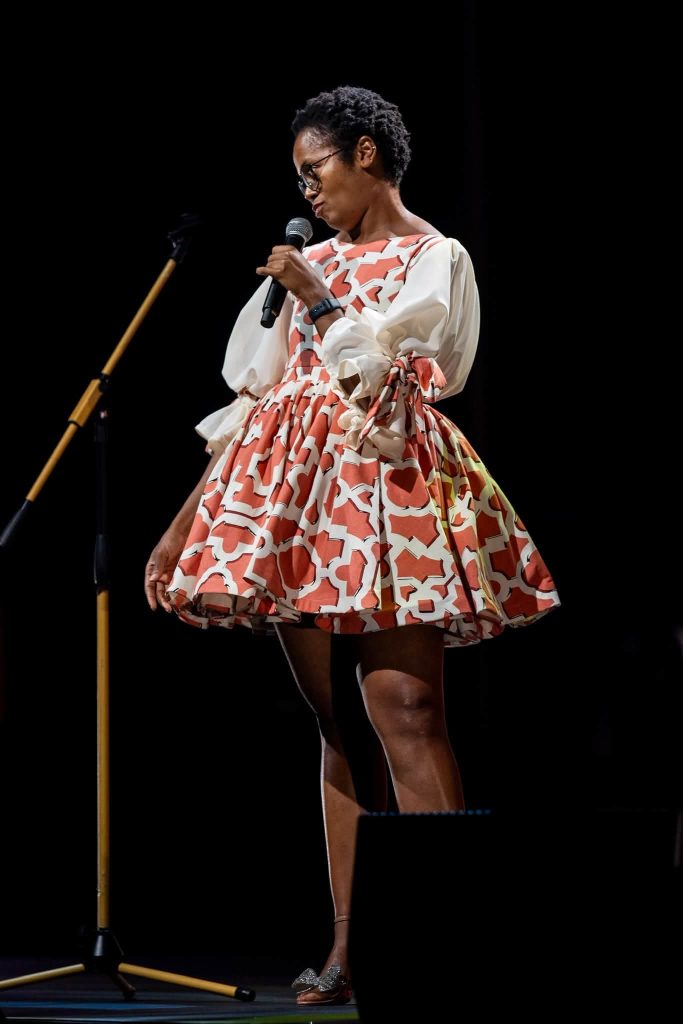
“If I had treated that night as the peak, everything afterwards would have been about trying to recreate it.”
Instead, she views the achievement as encouragement to continue building. There is a certain maturity in that perspective, particularly in an industry where recognition can quickly become another form of pressure. Once people celebrate you, there is an expectation that the next achievement must be bigger. The next performance must be better.
The next project must surpass the previous one.But careers do not always follow such convenient narratives.
“I’ve had to learn that a career isn’t a straight line. There are incredible highs and there are moments where you question everything.”
A decade into her comedy journey, she remains proud of the fact that she is still here, still creating and still finding reasons to challenge herself. And perhaps that longevity says more about her commitment than any individual award could.Her creative ambition is also evident in Comedy Meets Gospel, a concept that brings together two defining elements of her identity: faith and laughter.It is an unusual combination only if one assumes that spirituality and humour must occupy separate spaces.
Nonto sees things differently. For her, there is an important distinction between laughing about the human experience of church and mocking God.Church is filled with personalities, traditions and everyday situations that people recognise. The ushers, announcements, church mothers, pastors and familiar experiences of worship all provide opportunities for humour.
“My intention is never to disrespect what is sacred to people. In fact, I think Comedy Meets Gospel works because there is genuine love behind it.”
Her vision was to create an environment where audiences could laugh until their stomachs hurt and, moments later, be moved by a gospel performance. What began as an idea that might have sounded unusual to some has developed into a concept that has received national recognition.It also reveals an important dimension of Nonto’s career. She is not content simply to perform. She is interested in creating experiences, developing ideas and exploring opportunities that bring different audiences and creative expressions together.
WHEN LIFE BECOMES MATERIAL, THE LAUGHTER CARRIES A DIFFERENT WEIGHT
Comedy often gives audiences the impression that everything is lighter than it really is. A comedian tells a story, the audience laughs and the moment passes. What the audience does not always see is the personal experience that sits behind the punchline.For Nonto, comedy has become a way of processing difficult experiences. Some moments in life are not funny when they happen. They only become stories that can be approached with humour after time, perspective and, sometimes, healing.
“I’ve learned that pain and humour can exist in the same place.”
It is a powerful observation because it captures something essential about the relationship between comedy and vulnerability. Being able to laugh about an experience does not mean that the experience did not hurt. It means that the person telling the story has found another way to relate to it.
“This thing happened to me, but it doesn’t own the ending of the story.”
That sentiment becomes particularly significant when the conversation turns to family and motherhood.
Nonto is a proud mother of five. She has four biological children, including her second-born son, whom she sadly lost in 2009. That same year, her niece was born, and she has been raising her as her own daughter.It is a deeply personal part of her life, one that speaks to the complexity of motherhood, love, loss and resilience.
She describes motherhood as one of the most beautiful and challenging experiences of her life, teaching her unconditional love, sacrifice and the importance of being present.Her family has seen every version of her: the comedian, the mother, the wife, the producer, the dreamer and the woman who occasionally returns home exhausted from work and has absolutely no desire to entertain anyone.
“My family keeps me grounded because, at home, I’m not the award-winning comedian. I’m just Mom!”
There is a refreshing honesty in that distinction. The person audiences celebrate on stage does not automatically become the person who must exist at home. There are school and family responsibilities, schedules to negotiate and moments when the demands of entertainment compete with the desire to be present.Nonto also understands the importance of protecting certain family experiences from public consumption.
Although motherhood and family life inform her comedy, not every story belongs on stage.Ultimately, she sees what she is building as something bigger than personal recognition. She wants her children to grow up seeing a woman who pursued her ambitions, faced difficult circumstances and refused to allow those circumstances to determine what was possible.
SHE DIDN’T WAIT FOR A SEAT AT THE TABLE. SHE STARTED BUILDING THE ROOM.
That desire to create something beyond herself is equally visible in her work through Women in Comedy.The initiative reflects her understanding of the challenges women face in an industry that has historically been dominated by men. For women, the challenge is often not simply proving that they can be funny, but establishing themselves as comedians without having their abilities constantly qualified by gender.
Nonto recognised that waiting for opportunities to arrive was not always going to be enough.
“Sometimes you can spend years waiting for somebody to create space for you-or you can start creating the space yourself.”
Through producing shows, creating opportunities, building relationships and sometimes investing her own resources, she has taken an active role in developing platforms for women.Her approach to younger female comedians is particularly important. She is not looking to create another version of Nonto R. She wants women to develop the confidence to discover and express their own identities.
“I want them to have the confidence to become completely themselves.”
It is an understanding of mentorship that goes beyond simply opening doors. It is about ensuring that those who walk through them are free to bring their own ideas, personalities and creative instincts.For Nonto, if Women in Comedy can make another woman’s journey slightly easier than hers was, then the work has achieved something meaningful.
THE THIRD GIG: THE NIGHT THAT ALMOST ENDED HER COMEDY DREAM.
For all the awards and achievements, one of the most important lessons in Nonto’s career came during her third performance.It was around 2015 or 2016. Her first two performances had taken place in theatres, and both had gone exceptionally well. Naturally, she was beginning to feel confident about her new direction.Then came her first proper club gig.
The atmosphere was different. People were drinking, sitting around tables and having conversations. Four comedians performed before her, and none seemed to have particularly successful sets.Nonto was number five.And the experience was no better.The audience was not responding as she had hoped. The laughter was not coming, and the performance left her questioning whether comedy was really for her.
“I went home afterwards thinking, ‘Maybe this comedy thing isn’t for me”
It was a moment that could easily have become the beginning of the end. But about a week later, she performed in a similar club environment, using the same material. This time, the audience responded differently. It became one of her best performances, even earning her a standing ovation.The contrast taught her something that would remain with her throughout her career: one performance cannot determine whether or not she is a comedian.Comedy, she explains, has too many variables.
The room changes, the audience changes and even the mood of the people performing and watching can influence how a set unfolds.That experience fundamentally changed how she approaches the stage.Rather than immediately judging herself according to the audience’s reaction, she now considers whether she is enjoying the material, whether she believes in the story and whether she is genuinely passionate about telling it.”When I’m genuinely having fun on stage, audiences usually come along with me.”And when they do not, she does not automatically assume that her career is in trouble. Sometimes she needs to change the story, move to another subject or understand the room differently.Her conclusion is perhaps the simplest and most important lesson from that early experience.
A bad performance is exactly that-a bad performance. It is not a verdict on who I am or what I’m capable of.It is a lesson that extends well beyond comedy. In an industry where public response can sometimes feel like a measurement of personal worth, Nonto has learned not to allow one difficult night to define an entire journey.
THE WOMAN BEHIND THE LAUGHTER STILL NEEDS ROOM TO BREATHE.
There is one assumption about comedians that Nonto is particularly keen to challenge: the idea that people who make others laugh must always be happy themselves.
“I’m a human being before I’m an entertainer.”
It is a straightforward statement, but one that carries considerable weight. The expectation to entertain can sometimes make it difficult for performers to acknowledge their own emotional needs. A comedian can arrive at a venue carrying personal struggles, deliver a brilliant performance, take photographs with fans and return to a hotel room still dealing with the same challenges.Nonto understands that reality and has become more intentional about her wellbeing.She needs quiet, family, prayer, movement and moments when nobody expects her to perform.
She has also learned that rest should not be something reserved for the point at which exhaustion becomes unavoidable.”I’ve also learned that rest isn’t something you earn only after you’ve completely exhausted yourself.”Her interest in wellness reflects a desire to look after the person behind the public identity. It is about recognising that professional success cannot come at the permanent expense of personal fulfilment.She is learning to pay attention to the woman beneath the career, rather than allowing the demands of the career to consume everything else.And perhaps that brings us to the most important distinction in Nonto’s story.
She does not simply want to build a successful comedian. She wants to live a successful, healthy and fulfilled life.As she puts it, “I don’t only want a successful Nonto R. I want a healthy, fulfilled Nomthandazo too.”After a decade in comedy, two awards in one night, the creation of new platforms, the exploration of faith through entertainment and the experience of life’s most difficult personal moments, Nonto R has arrived at an understanding that goes beyond applause.
She knows that success is not measured by how many people laugh at your jokes, how many awards sit on your shelf or how loudly a room celebrates your name. It is also measured by what remains when the lights go off, when the audience goes home and when the stage no longer demands your attention.Her journey is still unfolding.
The comedian continues to create, the mother continues to nurture, the woman of faith continues to believe, and the creative entrepreneur continues to build.South Africa may know Nonto R for the laughter, but there is a much deeper story behind the punchlines.And if her journey has taught her anything, it is that you can experience pain without surrendering to it, pursue a dream without abandoning responsibility, create opportunities without waiting for permission and make a nation laugh without pretending that your own life has always been a joke.The applause may belong to Nonto R. The strength, the story and the woman behind it belong to Nomthandazo.